01 / PRODUCTION DECISION STUDY
Purpose of this decision study
This study helps SHARED owners compare choices before finalising the specification and assigning the development project. No application framework, database engine or analytics product is selected or recommended here.
An in-country primary with independent recovery is a proposed option. The client and operator must confirm hosting, residency, custody and costs under C07. The software stack, database, warehouse, reporting tools and recovery mode remain options for assessment.
Compare complete solutions against the same functional requirements, GIS workloads, security tests, recovery targets and three-year costs. Existing prototype technology is background evidence and a reuse consideration; it does not make that technology the production winner.
Use the comparison workshop and development-team handover sections below to record evidence, settle trade-offs and approve the final design. This page makes no infrastructure purchase or real-system change. Prototype previews do not establish production readiness.
02 / PRODUCTION DECISION STUDY
Current baseline and future selection
The current author issue is SRS Version 1.6. It describes required behavior and proposed logical boundaries. No installed application, real repository or operational service was inspected for this correction.
| Area | Current specification | Decision still needed |
|---|---|---|
| Core access | Responsive, low-bandwidth user journeys and authenticated service interfaces. | C06 confirms devices, languages and accessibility journeys. |
| Application | A modular application with shared business rules, explicit contracts and controlled data access. | C07 selects a supported implementation and operator. |
| Data | Relational and geospatial records, protected originals, versions, transactions, source rights and history. | C02/C04/E01 confirm meanings, ownership and mappings. |
| Service targets | Use the existing numerical proposals and conditions in the NFR annex. Browser checks are separate. | C05/C06/C07/C08 approve the complete measurement configuration. |
| Additional channels | Offline operation and additional field-access channels are conditional options. | C01/C06/C07 confirm need, scope, cost and support. |
03 / PRODUCTION DECISION STUDY
Hosting options and trade-offs
Hosting, residency, operator, recovery and custody remain pending C07. Compare independent failure domains, support obligations and complete lifecycle cost using the same agreed workload.
| Option | Meaning | Evidence needed |
|---|---|---|
| Institution-operated environment | Institution-managed facilities, application services, storage and independent recovery. | Facilities, staffing, monitoring, patching, recovery and funding. |
| Colocation or managed private environment | Institution-controlled service boundaries with contracted facility or operations support. | Exact site, responsibilities, capacity, support, custody and exit terms. |
| Managed hosting services | Contracted application, storage and recovery capabilities under an approved service boundary. | Residency, isolation, compatibility, recovery, charges and portability. |
| Governed hybrid arrangement | Approved operational and analytical boundaries with controlled data exchange. | Permitted data classes, identity, source rights, reconciliation, operating cost and independent recovery. |
| Reuse an existing institutional platform | Configure or extend an established service where it meets the accepted requirements. | Workflow fit, authority, permissions, integration, continuity and exit proof. |
No supplier, technology product, hosting country or operating commitment is selected by this page. Obtain comparable offers only after the requirement and measurement baseline is agreed.
04 / PRODUCTION DECISION STUDY
Technology-neutral hosting layout
Logical interface separation does not require separate deployment. Select the hosting arrangement after workload, privacy, availability, support and recovery decisions.
| Role | Boundary |
|---|---|
| Responsive interface | Uses authenticated service contracts and contains no data-store credentials. |
| Application services | Apply identity, institution and resource scope, validation, transactions and shared rules. |
| Relational and geospatial data | Use controlled operations, stable identities, versions and least privilege. |
| Document and object storage | Protect originals, approved derivatives, provenance and retention. |
| Integration adapters and jobs | Use approved source contracts, bounded retries, duplicate protection and reconciliation. |
| Recovery | Protect data, originals and keys independently. Measure restoration and continuity against the agreed service boundary. |
Roles may share a deployment where the accepted operational requirements permit it. Stronger deployment separation remains a proposed option under C07.
05 / PRODUCTION DECISION STUDY
Application, database and complete-stack options
Compare capability approaches against the same approved requirements, representative data and acceptance cases. No product, supplier or implementation framework is selected.
| Approach | Evidence needed |
|---|---|
| Extend an existing institutional platform | Demonstrate the complete retained workflows, source rights, authorization, reporting and exit. |
| Configure a supported modular application | Prove workflow fit, typed data, shared rules, governed configuration, tests and operator skills. |
| Build a governed extension using supported components | Explain the verified unmet need, contract boundaries, lifecycle cost and migration. |
| Add a specialist analysis adapter | Justify the approved scientific method, data volume, permissions and reproducible outputs. Do not replace the core without an accepted reason. |
Record native fit, configuration, extension, integration or unmet need for every accepted Must requirement. Keep unknown evidence visible. Reuse institutional sources of record instead of duplicating their systems.
06 / PRODUCTION DECISION STUDY
Warehouse design for large data
The operational database records transactions and approvals. The warehouse stores governed historical facts for analysis. Large photos, PDFs, satellite rasters and source archives belong in versioned file/object storage with catalogue links, rather than being duplicated inside every reporting table.
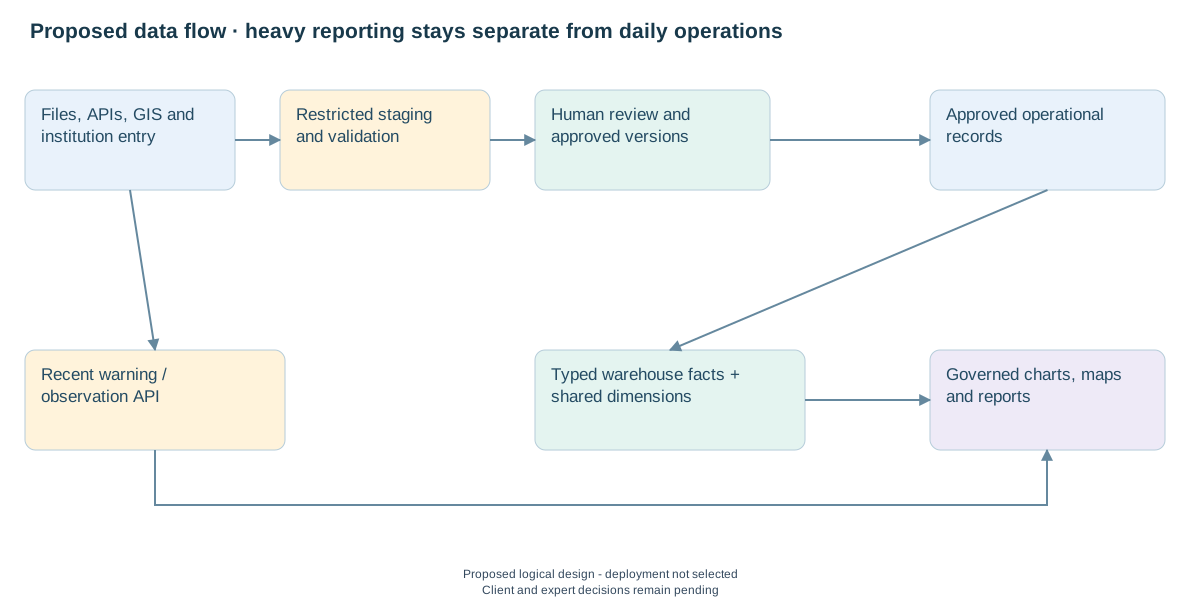
- Capture immutable source versions with institution, licence, classification, timestamps, place, unit, quality and original identifiers. A source record is not automatically approved institutional data.
- Land imports in restricted staging/quarantine. Validate schema, duplicates, dates, units, geometry and safe file limits. Automated extraction proposes fields; a different authorized human verifies them.
- Publish typed curated records after approval. Keep version and lineage links to originals. Corrections create traceable changes and update affected reporting partitions.
- Extract through approved stored-procedure/export contracts. Consider CDC only after a controlled compatibility, permission and log-retention assessment; monitor lag and reconcile counts.
- Build separate facts at explicit grains: station observation per timestamp/variable; reservoir reading per reservoir/time; farm-season crop result; project expenditure transaction; disaster impact by incident/place/report version. Never combine all meanings into one untyped value table.
- Reuse conformed dimensions: institution, domain/entity/attribute, geography and boundary version, observation/report date, project, source/version, unit, classification and approval state. Use effective-dated dimension versions when names or boundaries change.
- Load incrementally with watermarks, idempotent batch keys, late-arrival handling, rejected-row reports and reconciliation. Prove restart safety. Keep “missing” separate from zero.
- Evaluate engine-appropriate columnar storage or indexes for suitable large analytical facts, date partitioning where data volume and pruning justify it, reviewed aggregates, statistics and query plans. Too many small partitions can hurt. Benchmark rather than promise a fixed speed-up.
- Keep access decisions authoritative. Restricted warehouse rows, semantic models, cached results, exports and exact spatial data must remain scoped. Only explicitly approved public aggregates may enter a public cache. Current cross-request business-data caching rules are not silently relaxed.
Current implementation boundary: existing application framework runtime database access remains stored-procedure-only through software provider.Data.data-access adapter. That records the current code; it does not select the future stack. Any chosen alternative needs approved access contracts, equivalent authorisation/audit controls, migration design and an updated architecture decision before development.
07 / PRODUCTION DECISION STUDY
Data cubes and fast reporting
A cube is a prepared view of measures by dimensions, such as institution, district, crop and month. It can make repeated summaries easier and faster. It cannot fix incorrect source data, missing indexes, a slow network or unsafe joins. A modern tabular semantic model may meet the need without a traditional multidimensional cube.
| Analytics option | Advantages | Disadvantages | Use when |
|---|---|---|---|
| Relational star-schema warehouse + summary tables | Familiar relational modelling; governed API queries can serve charts. | More care is needed to govern shared measures and complex ad-hoc analysis. | Compare engine-specific summary performance and maintenance effort against the other approaches. |
| SSAS Tabular / governed semantic model | Shared measures, relationships and reusable analysis; familiar relational modelling. | Extra memory, model refresh, permissions, deployment and licensing. | An option for a compatible software provider analytics environment; compare licences, refresh, security and operating effort. |
| SSAS Multidimensional cube | Rich mature dimensional analysis for specialist requirements. | More specialised skills and model maintenance; hosting choices differ from tabular models. | Compare when specific dimensional features or an existing estate are relevant. |
| reporting service / Fabric warehouse and semantic models | Integrated pipelines, warehouse/lakehouse and visual analysis. | Capacity/licensing, residency, refresh behaviour, provider dependence and export controls. | Cloud analytics allowed and a costed proof of value succeeds. |
| analytical data store analytical service | Column-oriented analytics for high-volume event/time-series workloads. | A second engine, ingestion path, security model and specialist operational burden. | Benchmark as a later analytical sidecar; it does not replace the operational SQL system. |
| Object lake + Parquet/Iceberg + query service/Spark | Open-format history and large mixed-source processing. | More engineering, catalogue, file compaction, governance and support work. | Large files or varied historical workloads justify a lakehouse; do not add it for fashion. |
Example reservoir measure: storage utilisation = usable current storage ÷ usable capacity × 100. Both values must refer to the same reservoir, compatible units, definition version and time context. For several reservoirs use SUM(storage) ÷ SUM(capacity) × 100, not an unweighted average of percentages. A zero or missing denominator gives “not available”, not zero.
Do not sum reservoir stock across dates. Compute rainfall for an agreed station/area and time interval; do not add station totals to represent an area without a reviewed method. Count distinct project IDs after many-to-many joins. Ratios, stock, distinct counts and monetary values need different aggregation rules. Store formula version, parameters, source IDs, unit conversion, review decision and refresh time with every published measure.
08 / PRODUCTION DECISION STUDY
Fresh data, charts and maps
| Workload | Proposed path | Required controls |
|---|---|---|
| Official warnings and recent gauge observations | Validated recent-record store through the API; dedicated connector workers. | Show issue time, validity, observed time, fetched time and stale state. Never call an empty feed an all-clear. |
| Operational review and status | Authoritative operational API. | Read-your-work correctness and real identity; no warehouse delay hidden as current status. |
| Institution dashboards and trends | Incremental warehouse and optional semantic model. | Proposed refresh every 15–60 minutes or daily by use case; agree freshness targets and display successful watermark. |
| Long historical and spatial analysis | Scheduled warehouse/lake processing and governed map services. | Queue heavy work; timeouts/cancellation; coordinate and licence checks; reusable results scoped to the right audience. |
Use the existing geography/layer catalogue, stable IDs and boundary versions. Generate tiled/simplified map products for large public views instead of sending millions of raw features. Keep full precision in protected storage. Serve large rasters as suitable tiled/overview products with approved providers. Recheck access for map queries and downloads; a hidden legend is not security.
Spatial options include relational data store spatial, relational and geospatial data stores and governed GIS services, with open-source or commercial service tools. Compare supported spatial operations, scale, licence, disclosure controls and local skills. Reuse the canonical geography catalogue; map/chart filters must share stable place, period, source and record identities.
09 / PRODUCTION DECISION STUDY
Backup and recovery choices
Choose backup and continuity arrangements against the existing proposed NFR conditions, then obtain C07/C08 approval. A publication mirror is not automatically a recovery service.
| Arrangement | Required proof |
|---|---|
| Independent recoverable backups | Restore records, originals, configuration and keys into an isolated target. Reconcile counts, versions, permissions and evidence. |
| Prepared recovery environment | Measure change lag, activation, protected access and complete recovery. Prevent duplicate scheduled work. |
| Managed recovery service | Confirm the service boundary, site independence, retention, custody, support and tested recovery terms. |
| Exit or supplier replacement | Demonstrate portable data/metadata export, documented dependencies and receiving-team restoration. |
Retain copies independently from the primary failure domain and protect them against unauthorized alteration. Agree retention, alerts, response and recovery authority. A successful browser demonstration cannot establish these operational controls.
10 / PRODUCTION DECISION STUDY
Security and data protection
| Control area | Production requirement | Proof to collect |
|---|---|---|
| Network | Private database and storage networks; TLS; VPN/bastion for administration; WAF/rate limits; restricted service egress. | Network diagram, firewall review and denied-path tests; no exposed SQL or unrestricted administration. |
| People and accounts | Compare identity components suitable for each stack. Preserve the SRS access policy, require privileged MFA, and separate human/service identities. Current framework details do not preselect future identity technology. | Join/move/leave tests, independent privilege approval, session revocation, break-glass procedure and periodic access review. |
| Data and encryption | Encrypt traffic and stored data/backups; separate key custody; classify source and derived data; generalise sensitive coordinates. | Key rotation/recovery exercise, cross-institution/classification denial, retention and export tests. |
| Files and document processing | Quarantine, malware scan, safe parsers, file limits and immutable originals. Treat uploaded text as untrusted input to any automated extraction. | Malicious-document tests, human correction, extraction confidence/lineage, no automatic privilege or approval from document content. |
| Analytics | Apply scope before rows, counts, aggregates, model refresh, downloads and cached results. Test inference/small-cell disclosure. | Denied aggregate/export tests, identity-to-model mapping, cache isolation and withdrawal/reclassification invalidation. |
| Supply chain | Signed/versioned releases; dependency and secret checks; reviewed migrations; separate environments. | Software inventory, patch plan, authorised penetration test and resolution of critical/high findings. |
| Operations | Central monitoring and protected audit, on-call cover, incident response, backup administrator separation and recovery drills. | Alert delivery exercises, reviewed logs with no sensitive content, named owners and documented response times. |
For reporting service, “Publish to web” exposes content publicly and must not be used for private institutional data. Use an appropriately licensed secure embedding and identity model, or keep chart rendering within the authorised SHARED API path.
[23] reporting service public sharing warningSri Lanka hosting alone does not settle privacy compliance. Verify applicable law, institution rules, purpose, lawful handling, retention, subcontractors and cross-border transfers with the authorised privacy/legal reviewer. Check the exact location of backups, telemetry, support access and automated document-processing services as well as the main database.
[24] Sri Lanka Data Protection Authority11 / PRODUCTION DECISION STUDY
Capacity planning and measurement
User count, file growth, sensor frequency and retention are not yet agreed. The following are workload envelopes for testing, not predictions, procurement sizes or proof that a server can meet them.
| Scenario | Planning workload | Infrastructure evaluation |
|---|---|---|
| Controlled launch | 100 concurrent users; 10 million analytical rows/year; 1 TB initial files. | Separate application, database and protected storage roles. Pilot a reporting instance rather than one shared VM. |
| Institution expansion | 300 concurrent users; 100 million analytical rows/year; 10 TB files. | Independent reporting compute, incremental processing, object/file tiering, map tiling, warm recovery capacity and load testing. |
| High-volume monitoring | 1,000 concurrent users; 1 billion analytical rows/year; 100 TB files/rasters. | Partitioned warehouse/lake evaluation, specialised ingestion and spatial services; benchmark distributed analytics only if needed. |
Count actual rows/day and bytes/row, including indexes, history, audit, staging, rejected rows, temporary working space and headroom. Stored files, warehouse copies and backup retention need separate estimates. A source snapshot is not the complete annual dataset.
Illustrative node ranges for a pilot only: Web/API 4–8 vCPU and 8–16 GB RAM per instance; operational database 8–16 vCPU and 32–64 GB RAM; independent warehouse 8–16 vCPU and 32–128 GB RAM; workers 4–8 vCPU and 16–32 GB RAM. These are starting benchmark candidates, not capacity guarantees. Reserve physical-host overhead, storage IOPS, backup bandwidth and recovery resources; do not place all roles on one undersized host.
Simple sizing check
Illustrative defaults. Edit them; no values are saved or sent.
Decimal GB/TB. Analytical size = rows/day × 365 × years × bytes/row × allowance. This excludes originals, replica copies, backups and temporary space. Ideal transfer hours = GB × 8,000 ÷ Mbps ÷ 3,600. Real transfers take longer.
For example, 2 TB over a fully available 100 Mbps link takes at least about 44.4 hours before overhead. A remote VPS is not a four-hour recovery plan if the full dataset must first be copied during an incident. Pre-seed and verify the standby, then measure change rate and catch-up time.
12 / PRODUCTION DECISION STUDY
Costs and procurement
No supplier quote has been obtained. Compare three-year total cost, not the monthly VPS price alone. Amounts below are entered by the reviewer in one chosen currency; they are not live prices or a bill of materials.
Three-year cost worksheet
Enter every cost line, including an explicit zero where justified. A blank is unknown and does not produce a comparable total. Base cost = one-time + 3 × annual + 36 × (monthly primary + monthly recovery). Total = base × (1 + contingency/100). Include each expense once; taxes, inflation and exchange-rate changes are separate unless included in your entries.
| Cost line | What to include in the quote |
|---|---|
| Hardware and facility | Servers, storage, switches/firewalls, UPS/generator, rack/cooling, spares, replacement and warranty; colocation instead if applicable. |
| Software | Selected OS/database/virtualisation, reporting or semantic-model rights, security/backup tools, GIS and document-processing licences; production and standby rights. |
| Recurring service | Electricity, cooling, ISP/VPN links, VPS, off-site immutable backups, monitoring, security, traffic/egress and vendor support. |
| People | DBA, systems/network administrator, security/on-call cover, data engineering, application support and leave/incident backup. |
| Delivery and exit | Migration, cleansing, load/security/restore tests, training, deployment and rollback drills, external review, data export and provider exit. |
Require two or more comparable written offers. Ask every supplier for actual country/site, independent failure domain, guaranteed/reserved CPU/RAM, sustained IOPS and latency, uplink limits/fair use, restore rights, database edition/licensing, backup retention/immutability, root access and patch responsibilities, DDoS response, escalation times, data ownership, audit evidence and exit/export terms. A published product page is not a signed service commitment.
13 / PRODUCTION DECISION STUDY
Compare from every decision angle
Run a structured decision workshop before awarding development. Apply the same requirements, representative data, hardware budget and test scripts to every complete-stack candidate. No scores or ranks have been invented.
| Decision angle | What every candidate must demonstrate |
|---|---|
| SRS and user experience | Entry/upload/review, institutional workspaces, reports, library, multilingual accessibility and mobile flows. |
| Data integrity and GIS | Transactions, duplicates, historical versions, stable geography, coordinate/spatial operations and source lineage. |
| Performance and analytical growth | Same dataset and mixed workload; p95/p99, imports, query plans, storage growth and reporting freshness. |
| Security and privacy | Institution/classification denial, MFA, files, sensitive locations, exports, aggregation and audit; mandatory risks cannot be traded away. |
| Availability and recovery | Tested database/file/key recovery, standby lag, real RPO/RTO, power/network failure, failover and failback. |
| Delivery and team capability | Scope to rebuild/reuse, migration risks, development/test effort, verified local skills and team continuity. |
| Operations and maintainability | Patching, monitoring, incident cover, automation, supported versions, documentation and vendor/community support. |
| Whole-life cost, ownership and exit | Licences plus staff/hosting/DR; institution-owned source and data; portable exports, replacement supplier and exit costs. |
- Agree pass/fail gates first: required functions, lawful data handling, access isolation, critical security findings, required GIS behaviour, recoverability, data/source-code ownership and a supportable operating plan. A high weighted score cannot compensate for a failed mandatory gate.
- Ask for evidence: a small common prototype, independently checked security cases, timed load/import tests, a real isolated restore and a comparable three-year quote. Include licence, support, migration and exit assumptions.
- Agree weights before viewing results. A possible scoring method is 1–5 per criterion, with written evidence: total = SUM(weight × rating) ÷ (5 × SUM(weights)) × 100. This is a method option, not a product recommendation. Zero total weight or missing ratings means no comparable total.
- Only compare complete, gate-passing candidates. Record failed and untested gates, uncertainties, different confidence levels, reviewer names and dates. Do not silently score an unknown capability as zero or treat a vendor claim as a passed test.
- Review sensitivity: change reasonable weights, consider growth, loss of key staff, supplier exit and a primary-site outage. If the order changes easily, document that uncertainty and run another targeted test.
- The commissioning institution approves the final choice and its trade-offs. Publish the agreed decision and update the SRS/architecture before the development team commits to delivery.
Download the blank decision comparison worksheet. Ratings, weights, mandatory-gate results, evidence and approval fields are intentionally blank.
14 / PRODUCTION DECISION STUDY
Phased implementation and release gates
| Phase | Deliverable | Acceptance before moving on |
|---|---|---|
| 1 · Confirm the workload | Institution inventory, file/sensor growth, critical workflows, data classification, hosting residency, owners, budget and recovery tier. | Signed assumptions and measures. Pilot dataset authorised. No production purchase from prototype counts alone. |
| 2 · Build an isolated production-like platform | Logical interface, service, data, job, storage and monitoring boundaries, controlled deployment and protected backups. | Real identity and private files work through the API; approved least-privilege data-access contracts and denied-scope tests pass. |
| 3 · Prove the warehouse | One rich institution pilot, typed facts, conformed dimensions, incremental loads and reviewed measures. | Reconcile source/approved/warehouse counts, corrections and units. Benchmark the shortlisted warehouse and semantic approaches under the same workload. |
| 4 · Prove recovery and security | VPS seeded, independent immutable copy, key recovery, full failover/failback rehearsal and authorised security review. | Measured end-to-end RPO/RTO; no unresolved critical/high security findings; duplicate jobs prevented. |
| 5 · Institution acceptance | UAT in English/Sinhala/Tamil for entry/upload/review/charts/maps/reports/library/access; training and operating guides. | Real users approve workflows and calculations. Providers approve data use; support team accepts runbooks. |
| 6 · Controlled release | Approved migration window, reconciled cutover, rollback criteria, progressive traffic and hypercare. | Named go/no-go authority, tested rollback, alert delivery and incident cover. Preserve historical IDs and records. |
| 7 · Grow from measurements | Add resources, partitions, semantic models or specialist analytical engines only when justified. | Cost/performance evidence and an approved architecture decision; no silent core-database replacement. |
A delivery calendar follows workload approval, supplier lead times and a scoped pilot. This report does not promise a production completion date. The prototype demonstrates the intended experience; it does not close the engineering, legal, security, institutional or operational acceptance gates.
15 / PRODUCTION DECISION STUDY
What to hand to the development team
Turn the approved study into a clear development brief. Keep open decisions visible; do not let a prototype screen or supplier assumption become a hidden contractual requirement.
| Handover item | What must be agreed |
|---|---|
| Scope and acceptance | Versioned business SRS, priorities, institution workflows, prototype links, exclusions and testable acceptance criteria. |
| Selected architecture | Approved framework, database, hosting/DR, analytics and identity decisions with alternatives considered, supported versions, licences and reasons. |
| Data and calculations | Canonical IDs and hierarchy, migration mappings, typed schemas, warehouse grains/dimensions, source rights, units and reviewed formula versions. |
| Interfaces and integration | API contracts, import/export formats, connector credentials/approval process, retries, ownership and real versus demonstration behaviour. |
| Security and operations | Access matrix, privacy/data location, file handling, audit, secrets/key custody, monitoring, patching, incident and backup/restore responsibilities. |
| Measured service targets | Accepted load, growth/freshness assumptions, p95/p99 goals, availability and end-to-end RPO/RTO with a common verification plan. |
| Delivery and commercial terms | Milestones linked to evidence, cost assumptions, change control, source-code/data ownership, institution-controlled repositories and build/deploy access. |
| Transfer and support | Documentation, automated tests, operating runbooks, team training, warranty/support, recovery drills, supplier replacement and usable exit exports. |
Approval of a technology choice is separate from acceptance of delivered software. Require institution UAT, independent security/recovery evidence and a named production go/no-go decision before launch. No development contract or production approval is issued by this page.
16 / PRODUCTION DECISION STUDY
Responsibilities and open decisions
| Owner role | Must decide or prove |
|---|---|
| Product owner / institution stewards | Critical workflows, source ownership, review authority, retention, freshness, accepted outage/data loss and validation of measures. |
| Solution architect and application lead | Keep module/API contracts, prove integration boundaries and record approved design changes. |
| Database and data-engineering leads | Measure data growth and queries; design warehouse grains, incremental loads, permission-safe measures and recovery chains. |
| Systems/network operations | Facilities, host/storage sizing, redundant links, patching, certificates, workers, monitoring and standby activation. |
| Security and privacy leads | Threat model, MFA, scoped access, audit, safe file/automated processing, classification and supplier/residency review. |
| GIS/scientific experts | Spatial definitions, boundary versions, scale/precision, map service rights and scientific calculation validity. |
| QA and release authority | Performance/security/restore/UAT evidence, unresolved-risk review and final go/no-go. |
| Finance and procurement | Comparable three-year quotes, licence entitlements, maintenance coverage, support contracts and exit rights. |
Outstanding: actual user/load growth; exact primary premises; VPS country/facility and independence; critical-service recovery tier; restricted data allowed on DR/analytics services; staffing/on-call coverage; vendor and licence quotes; institutional acceptance and measured load/restore results.
17 / PRODUCTION DECISION STUDY
Sources and review basis
Research references include additional framework, database and recovery references for this neutral decision study. Official documentation supports feature descriptions. Candidate stacks, sizing envelopes, schedules and the comparison method are planning inputs, not supplier promises or selected products. Recheck versions, licences, region availability and prices before contracting.
- Retained external technical reference 1
- Retained external technical reference 2
- Retained external technical reference 3
- Retained external technical reference 4
- Retained external technical reference 5
- Retained external technical reference 6
- Retained external technical reference 7
- Retained external technical reference 8
- Retained external technical reference 9
- Retained external technical reference 10
- Retained external technical reference 11
- Retained external technical reference 12
- Retained external technical reference 13
- Retained external technical reference 14
- Retained external technical reference 15
- Retained external technical reference 16
- Retained external technical reference 17
- Retained external technical reference 18
- Retained external technical reference 19
- Retained external technical reference 20
- Retained external technical reference 21
- Retained external technical reference 22
- Retained external technical reference 23
- Retained external technical reference 24
- Retained external technical reference 25
- Retained external technical reference 26
- Retained external technical reference 27
- Retained external technical reference 28
- Retained external technical reference 29
- Retained external technical reference 30
- Retained external technical reference 31
- Retained external technical reference 32
- Retained external technical reference 33
- Retained external technical reference 34
- Retained external technical reference 35
- Retained external technical reference 36
- Retained external technical reference 37
- Retained external technical reference 38
- Retained external technical reference 39
Current basis: SRS Version 1.6, its calculation appendix, acceptance annex, source register and Institution review. Platform, permissions, workload, costs and operational acceptance remain pending.